TL;DR: a founder's guide to a16z speedrun. How it works, which signals matter most, and how to position yourself and your startup to get in. Everything I wish I had before our speedrun interview: the questions, the hidden signals, and the sauce that matters most. Bookmark this if you are applying.
Applications for SR008 open on Monday, October 12. I first wrote this in June 2024 and it has been updated a few times since. This version is rebuilt for SR008, with what changed and what the partners now say about how they pick.
#How this guide came together
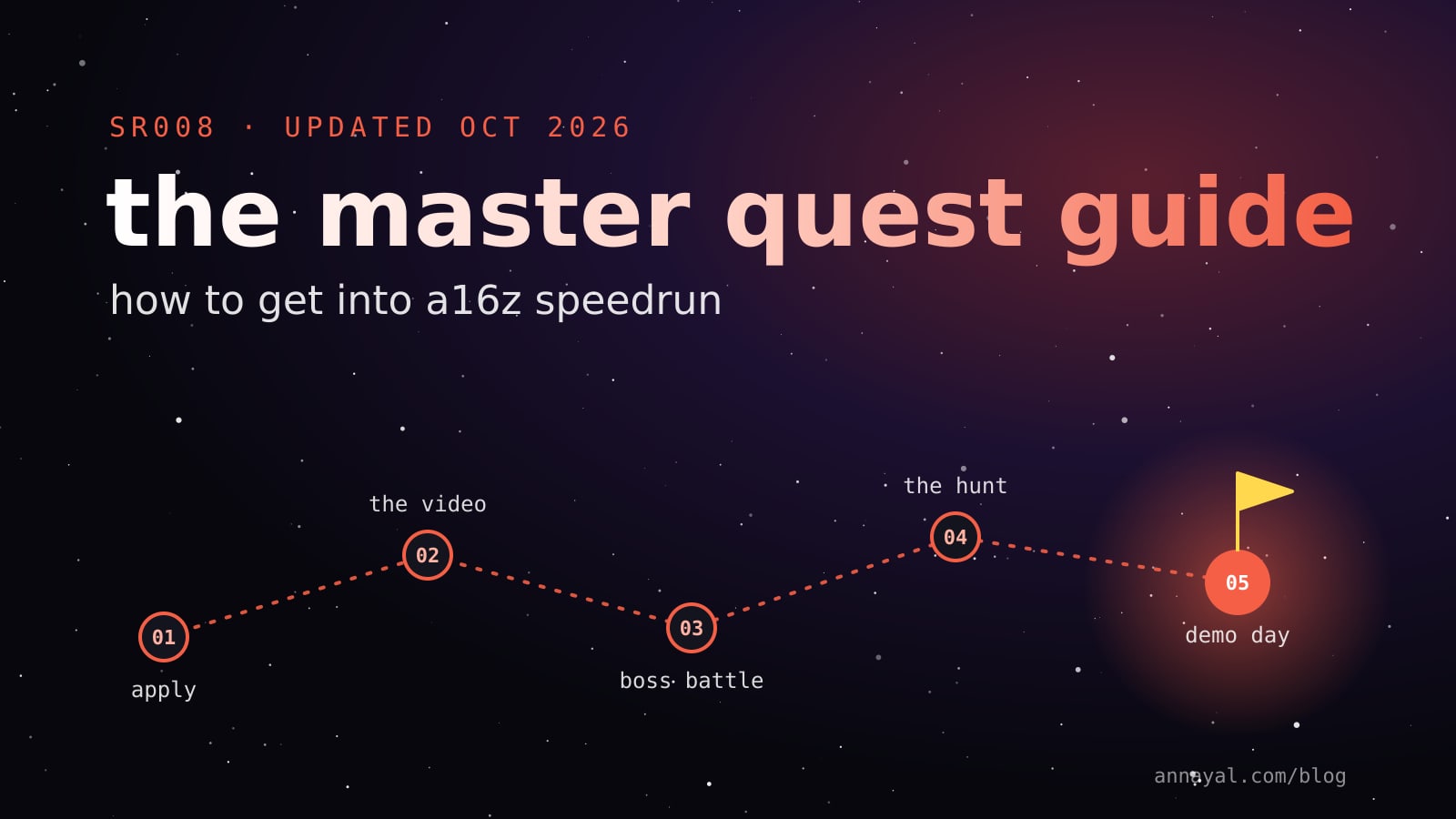
I got invited, as founder and CEO of Flamme, to interview with speedrun. To make sure we put our best foot forward, I spoke with 20+ alumni who had made it through the interview and into the program. Their insights, plus my own research, turned into a cheat sheet. I called it the master quest guide, because it was a16z GAMES after all.
I am sharing it so other founders can spend their time levelling up their interview skills and company knowledge, instead of grinding through research on what the interview might look like.
Important: we are not speedrun alumni. Flamme was bootstrapped. This guide is a compilation of that research and of my conversations with the speedrun team and alumni over the last two years, now updated with what the partners said in the run-up to SR008.
#What changed for SR008
If you read an earlier version, here is the delta.
- It is no longer a games accelerator. speedrun opened up to tech and entertainment startups in March 2025, and Josh Lu now calls it a horizontal program. SR007 had defense, satellite and datacenter companies in it.
- The deal is up to $1M. $500K for 10% upfront on a SAFE, plus another $500K in your next round within 18 months.
- The odds got brutal. SR007 had 30,000+ applications for just over 80 spots. That is roughly 0.27%.
- There is a priority window. Apply between October 12 and November 1 for the fastest review. They accept applications year-round, but early apps get the first look.
- The program is in San Francisco, late January through April 2027, 12 weeks, in person.
- The partners told us where they look. Troy Kirwin says they spend about 80% of their review time on the team and bio section. More on that below.
#But first, what is a16z speedrun?
speedrun is Andreessen Horowitz's accelerator for very early companies. It started inside a16z GAMES as an accelerator for games and tech, and it is now open to almost any consumer, AI, entertainment or deep tech startup. You get capital, a curated set of coaches and mentors, a community of very ambitious founders, and a Demo Day at the end.
In one line, it is the best way for founders, especially non-pedigree ones, to get the a16z stamp and access to their network, apart from a chunk of cash.
| SR008 | |
|---|---|
| Check | $500K for 10% upfront, on a SAFE |
| Follow-on | Another $500K in your next round, within 18 months |
| Also | Pro rata in later rounds, no board seat |
| Credits | Over $10M in cloud, AI and software credits (per their site) |
| Program | 12 weeks, late January to April 2027 |
| Where | San Francisco, in person |
| Ends with | Demo Day |
| Decision | Rolling, usually 4 to 6 weeks after you apply |
You also get a team, not one partner. Troy put the speedrun team at about 40 people, roughly eight of them investors. The rest are operating partners who help with launches, coming out of stealth and your first hires. As Seeam Noor put it, building a company is lonely and painful, and having the team and the other founders in it with you makes the pain easier to carry.
If you are a student or recent grad engineer, look at Alpha too. It backs students and recent grads with up to $250K. The deadline for the current cohort is October 11.
#The odds, cohort by cohort
| Cohort | Applications | Accepted |
|---|---|---|
| SR004 | 6,000+ | about 40 |
| SR005 | 10,000+ | under 0.5% |
| SR006 | 19,000+ | 70+ |
| SR007 | 30,000+ | just over 80 |
Roughly 10% of applicants make it to a video call. So the written application is the real filter, and that is where most founders put the least effort.
#What speedrun really screens for (beyond the obvious)
This is the pattern I saw across the 20+ alumni I spoke to, and it still holds:
- Products that could go viral just by existing.
- Founders who have already shipped multiple times, in public.
- Audacity over polish.
- Velocity over vision decks.
- A distribution edge over AI novelty.
#Lvl 1: the application
Here is the part most founders get wrong. The deck is not the application. You are.
Troy Kirwin: "We probably spend 80% of our time looking at the team and bio section." They want the things that don't shine through on a LinkedIn page. What makes you unique, the grit, the tenacity, the ability to ship zero to one.
So write the bio like it is the whole application, because it mostly is.
- Brag. Seeam Noor: "This is not the place to be humble." Research papers, a following, a side project that blew up, the odd story of how you got here. Seeam's point is that the best stuff often only comes out deep into a call, so put it in writing.
- Get a second pair of eyes. Troy's tip is to hand your application to a friend and ask what you left out. The research paper, the 30,000 Twitter followers, whatever you were too modest to mention.
- Traction can be words. You do not need $100K ARR. "We started two weeks ago and these three respected people in our space validated it and agreed to advise" is traction. If you have numbers, include them.
- Show slope. Kenan Saleh says that before traction they look for slope anywhere. How much you learn between calls, how fast you rose at your last job.
- Ship something. With vibe coding there is no excuse not to have a v1. Link the product or a demo.
- Keep the deck short. Josh Lu has said seven slides max.
- Get a warm referral. It bumps you up the review queue (more on that in Jonathan Lai's tips below).
- Don't overwork it. Kenan's rule of thumb: if you have ten hours, spend 9.5 talking to customers and building, and half an hour on the application.
- You don't need to have quit yet. Kenan says they have backed plenty of people before they left their jobs, and the money is what lets them quit. What they need is that you are fully bought in on going full time.
- Don't wait for the perfect idea. Troy's advice: if you know who you want to build with, that's enough. Go all in on an idea and validate it instead of spending nights and weekends hunting for the perfect one.
#Lvl 2: the video
Founders lose sleep over the video. They shouldn't.
They want you, maybe with your co-founder, talking earnestly about what you are building. Kenan called it more a test of communication than of the exact words. Seeam was clear that they are not marking you down on production quality. A few takes are fine. A rough script is fine.
The one thing to avoid is AI voice generation. Troy called it the exact opposite of what they want. They are trying to hear how you talk.
Emily Bennett had the best line on pacing: "Catch me in the first two." Put your strongest thing in the first two minutes, not the last 25.
#Lvl 3: the beginning of the quest (the invite email)
If the application lands, you get an email inviting you to schedule an interview. Here is roughly what ours said:
- Schedule your interview slot as soon as possible, availability is limited.
- Send your cap table to the provided email before the interview.
- Interviews are 15 minutes long, on Zoom, with multiple partners.
- Be ready for a fast-paced, high-intensity conversation, with interviewers cutting in to keep things moving.
- Interviews are recorded for partners who can't attend live.
- Expect feedback within a week.
For SR008, the partners describe it as a 10-minute interview and the FAQ says 15, so plan for 10 to 15 minutes, usually with two or three investors.
#Lvl 4: sharpen your sword (preparation)
#The process logistics
- Interviews range from one to five sessions. It starts with the short first call and can expand into deeper discussions if you make it through. The FAQ now says there can be a few more screening calls and that they may ask for references or data.
- They might ask to dig into your metrics dashboards, and even your bank statements to see where the money has been going. Prepare these beforehand so it isn't a shock during the interview.
- The first interview usually has one or two partners. Later rounds may bring in a broader panel.
#The people you might meet
These are the people alumni most often mentioned from the first round, plus who is reviewing SR008 applications now.
- Andrew Lee. Very nice person, and he will drill into you and why you are the right person and team. Be ready to talk about your superpowers as a CEO. He hosted the partners' pre-SR008 Q&A.
- Troy Kirwin. Gave founder friends of mine good feedback back in 2024, and is now one of the investors reviewing SR008 applications. He is the one who says 80% of the review is the team section.
- Emily Bennett, Kenan Saleh and Seeam Noor. The other investors reviewing SR008 applications. Emily watches co-founder dynamics, Kenan looks for slope, and Seeam wants your story.
- Josh Lu. I connected with him over messages, good vibes. He now runs speedrun as general manager.
- Jack Soslow. Nice, and stricter. He wanted the why behind every number and would not stop until he understood it. He loved core game loop mechanics, like fragging in Call of Duty. He left in January 2025 to build his own startup.
- Colin Campbell and Robin Guo. Gave other founder friends good feedback when I was preparing. I didn't interact with them personally.
- The GPs. Andrew Chen and Jonathan Lai.
#Essential tips
- Concise and confident. Be clear, direct and brief. They appreciate it.
- Focus on retention. Show the mechanics that keep users coming back. It is a critical metric for them, and it makes sense: with a leaky bucket you will find it really hard to grow. For reference, Flamme had 45%+ D30 bounded retention as a consumer AI app, and some gaming startups I talked to had 15 to 20% D30 retention with a high ARPU of $150 to $200.
- Know your earned secret. What do you know about your industry that others don't? Listen to this a16z podcast with Ben Horowitz for the deeper version.
- Know your market better than they do. Emily's test: if she brings up a competitor, you should know it. That comes from talking to the market every day, not from revenue.
- Prepare for pushback. They will push back even on the things you have strong convictions about. That doesn't mean you are wrong. Stay firm in what you know and convince them.
- Show community impact. speedrun is a lot about the network, and it is only as strong as its individual nodes. Show how you give back.
- Understand their goals. Make sure your objectives line up with theirs. You raising after Demo Day shows speedrun works.
#Lvl 5: the boss battle (the interview)
#The elevator pitch
Start with a compelling introduction to yourself and your team. Your key achievements, what makes you different, and the vision behind the company. Aim to hook them in the first 30 seconds. Short and impactful is a thousand times better than long and fluffy. As Bruce Lee said:
"I fear not the man who has practiced 10,000 kicks once, but I fear the man who has practiced one kick 10,000 times."
Kenan's version of the same idea: the interview isn't really about the ten minutes. It is about all the hours you put in before it, and they can tell immediately whether you did.
#The questions (in no particular order)
These came from our interview and from the alumni I spoke to.
- You. What is your superpower as a CEO? Have you been a CEO before? Tell us about yourself and your company.
- Team. Who is on your team? What are its strengths and weaknesses?
- Product. What sets your product apart? What have you learned from doing this business (your earned secrets)?
- Retention. How do you keep users engaged? How is that different from your competitors?
- Market fit. How does your product fit the current market?
- Revenue model. How do you make money? Are you making any yet?
- Scalability. What does the product look like when the company hits $10M ARR? This one caught me by surprise and I struggled a bit. Have your roadmap for that stage ready.
- Market potential. What opportunity are you going for? Bring the metrics and data that show the growth potential.
- Competition. How do you stand out? What will the winner in this space do differently?
#Co-founder dynamics
Emily watches how co-founders engage on the call. How you give each other space, how you split roles, how you work together. Decide beforehand who takes which questions.
#Real experiences: others share their interview
- Tolimar's experience. On being succinct and ready for an intense back-and-forth. A firsthand account of how fast the interview moves.
- Hayden Ko's journey. Detailed notes on preparing, and on understanding a16z's focus areas so you can tailor your pitch.
#Lvl 6: what they're hunting for
speedrun is on the quest for the ultimate champions. It wants what every accelerator wants, but to spell it out:
- Demo Day heroes. Startups that deliver a stellar performance by Demo Day. Be the company that raises on Demo Day or makes big news, like a launch, a round or a technical breakthrough.
- Community legends. Teams that contribute to their users and to the community inside the cohort.
- Epic investments. Companies with the potential for legendary returns.
And one piece of sauce nobody tells you. The speedrun team watches your socials. If they see you are already building in public, learning fast and resonating with a tribe, it massively helps.
#Co-founders who just met
This comes up a lot. It isn't a dealbreaker, but what matters is time spent building together.
Troy's example is a hackathon. Twelve hours together where the biggest decision was McDonald's or Burger King isn't high stakes. Continuity and time are what build trust. If you met online, spend a week in the same room before you apply.
Emily said they have turned down teams that had only just come together, who then moved to the same city, worked out of one office for six months, and had the context they were missing.
Kenan looks at whether your backgrounds overlap enough that you plausibly would have met anyway. The Coinbase founders met through a Reddit post, but their backgrounds made it a reasonable match.
#Bonus: decode the FAQ
I added this after a lot of demand (and DMs). The official FAQ is helpful, but here is what it actually means if you are a founder trying to get in.
"We back early consumer tech products that are culturally significant." They are not just looking for tools. They want products that spark trends, memes or movements. If people would share your app in a group chat or screenshot it for IG or TikTok, you are on the right track.
"We care more about velocity than traction." You don't need big numbers, but you do need to show you can ship fast, experiment publicly and learn faster than others. MVP over pitch deck. Build in public if you can.
"From idea to launched product." You can apply without users or revenue, as long as you have a clear point of view, a demo, and the ability to build something shareable quickly.
"You don't have to be technical." They are fine with non-coders, but only if you can build scrappy v1s with no-code, design, video or viral content. Creative builders beat PowerPoint founders. The FAQ now adds that non-technical founders need a technical partner.
"We look for products people love and talk about." If your product doesn't have a built-in wow moment, you will struggle. Think emotional resonance, a viral use case, something people would post about unprompted.
#Bonus: three tips from Jonathan Lai
Jonathan Lai, one of the GPs, shared three quick tips for applicants:
- Brag about your team. Professional and academic achievements, side projects, awards, research papers, incredible personal stories. They look for a history of excellence and founder-market fit. What gives you an unfair advantage?
- Include a product link or video. There are so many ways to prototype or vibe code an app now that there is no excuse not to have a v1 of your vision. Even better if you have early validation that people want it: revenue, users, waitlist sign-ups.
- Get a warm referral. It bumps you to the top of the review queue. There are more than 600 speedrun alumni around the world and many more in the broader a16z network. The litmus test is whether you can network your way to them, because that is the work of an early-stage founder: recruiting, finding customers, fundraising.
#Lvl 7: post boss battle (loot and XP)
#Feedback and reflection
After the interview, reflect on the feedback you get. It is how you sharpen your pitch for the next conversation, with speedrun or anyone else.
#Staying engaged
Keep talking to the team even if the answer isn't an immediate yes. A long-term relationship opens doors later, and they are just super nice people.
Reapplying is normal. Troy talked about a team he passed on in the spring. They found a stronger idea, brought on three highly respected advisors in their space, and reapplied. What got them in wasn't traction. It was how well the idea fit the team.
#Conclusion: preparing for speedrunning
Preparing for a speedrun interview takes strategic planning, a clear understanding of your product, and the ability to communicate well. Learn from alumni, know your retention and your earned secret, and line up your goals with theirs.
The journey doesn't end with the interview either. Keep improving, keep the relationships warm (very important over time), and use the feedback.
And if you don't get in, remember we are doing one of the hardest things there is: building a business and selling something that didn't exist before. If not this door, another one will unlock. We will make them unlock 🔓
Good luck and light speed to all the aspiring speedrunners. And a16z speedrun, you guys are awesome. So long, and thanks for all the fish!
#Sources
- What Founders Ask Us Before Applying, speedrun, Oct 2026 (the partners' pre-SR008 Q&A)
- The deal, FAQ and apply, speedrun.a16z.com
- Meet the new a16z speedrun, a16z, Mar 2025
- How to get into a16z's super competitive speedrun, TechCrunch, Feb 2026
- Earned secrets, a16z podcast with Ben Horowitz
- Tolimar's interview post and Hayden Ko's write-up
- Alpha, for students and recent grads