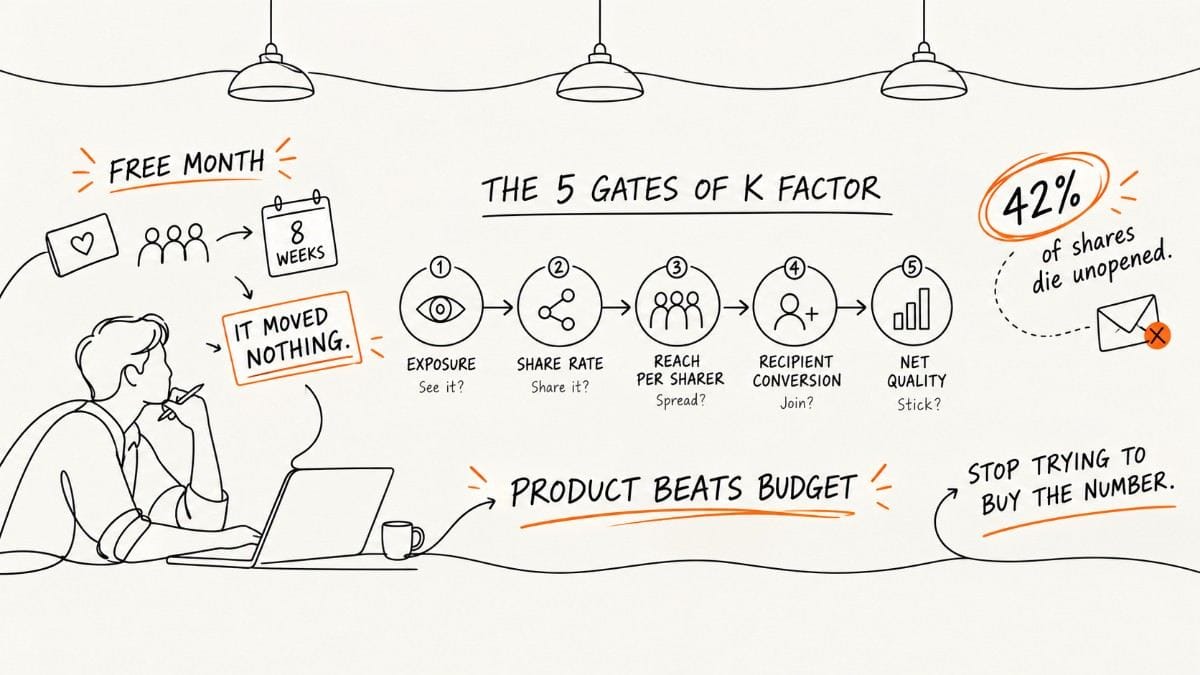
We once gave couples a free month to invite other couples. Eight weeks, roughly 10,000 users through it, a clean offer with a real dollar value. It moved nothing.
That was the week I stopped believing you can buy a K factor. If a free month of a product people already pay for cannot bribe an invite out of them, no amount of budget is going to.
Most founders never run that test. They assume virality is a spend problem or a content problem, pour money into whichever one they are more comfortable with, and wait for a number that is structurally never coming. So here is what the free month taught me, and what actually moved the loop instead.
#Money cannot pay off a social cost
An invite is not a transaction. It is a small social act. You are asking a favor of someone, and you are telling them something about yourself by the ask. On a relationship app, sending an invite says I use a relationship app, which is not nothing.
You can lower that social cost. You cannot pay it off. A free month sits on the wrong side of the equation entirely, because the thing stopping the share was never the price.
Every incentive we ever tested moved share rate by around five percent. Bigger offer, smaller offer, different framing, same result.
Five percent is not a growth lever, it is the sound a healthy funnel makes when you optimize it.
It is real, it is worth doing, and it will never take you to 2x. Founders who mistake that five percent for the path to virality spend years and a lot of money climbing a wall that tops out exactly where the mechanic says it will.
#The five gates, and only one takes money
K factor is not a single number you tune. It is five multiplied together, and each one is a separate gate a user has to clear.
- Exposure, how many users even see a share surface.
- Share rate, how many act on it.
- Reach per sharer, how many people each share actually lands in front of.
- Recipient conversion, how many of those become users.
- Net quality, how many of those stick and are worth having.
Multiply them. One weak gate collapses the whole number, no matter how strong the others are. In a typical referral program around 42 percent of shares die unopened before anyone even decides whether to convert, and most founders are not measuring that gate at all.
Here is the trap. Exposure is the only one of the five that money can touch directly. Buy content, buy influencers, buy placement, and you buy exposure. So founders who spend on growth genuinely feel like they are buying virality, because the one gate they can see moves. The other four are product, copy, and mechanic, and no invoice moves them.
#What actually moved it was product, not budget
The single biggest jump we got did not cost a cent, and it happened at the gate money cannot touch: recipient conversion.
Early on, the message that went out with a Flamme invite was generic. Same words for everyone. It converted the way a generic message converts, which is poorly.
Then we rebuilt it from the user's own data. The invite drew on what that specific couple had actually been answering inside the app, so the message that reached the partner understood the relationship it was talking about. It stopped being an app pitch and started being a message that only made sense between those two people.
Conversions jumped, and we paid nothing for it. A product-and-data decision beat every incentive we had ever tried, at the exact gate the incentives could not reach. That is the whole argument in one experiment: the invite got better because the product got smarter, not because the offer got richer.
#The loop has to live inside the value, not next to it
The reason our invite had something worth saying is that the share was built into the core of the product, not stapled to the edge of it.
The engine was a daily question. We asked one partner something small and warm, like one thing their partner did recently that made them smile. Answering it was the point of the app, the moment it paid off. And the answer was exactly the thing worth sending. So the partner got pinged: someone wants you to see what they said about you. The curiosity gap did the recruiting.
Notice what is not happening there. Nobody is being asked to market the app. The share is a byproduct of the user getting what they came for.
You cannot buy that placement, because it is not a placement, it is the shape of the product.
A share prompt bolted on after the value is a request. A share that is the value is a loop.
That is why content and incentives feel like growth and are not. They both live outside the loop. They rent you exposure or they discount your acquisition, and the second you stop paying, the number falls back to whatever the product itself earns.
#The part that makes it worth the effort
Here is why any of this is worth the years it takes. Blended CAC is your paid cost per user multiplied by one minus your K factor.
At a K of 0.1, you pay 90 percent of full price for every user. At 0.7, you pay 30 percent. That is a 3.3x gap on the cost of every single user you acquire, and it compounds against every channel you run. Your paid ads get cheaper. Your organic goes further. The same TikTok view is worth more because a fraction of the people it brings in bring in the next people for free.
No line item you can buy does that. You can buy a burst of exposure. You cannot buy the multiplier that sits under all your other spend and quietly lowers the price of everything.
If your growth plan is make more content and spend more, you are buying exposure and calling it virality. It is one gate out of five, and it is the only one money will ever open for you.
The message we attached to a share moved our numbers more than any dollar we ever spent on growth. That is not a budget you are missing. It is a loop you have not built yet.
Stop trying to buy the number. Go build the four gates you cannot pay for.
- An