
a16z just dropped the 6th edition of their Top 100 Gen AI Consumer Apps report.
900 million weekly ChatGPT users. CapCut on the list with 736 million mobile MAUs. Agents entering the mainstream. The numbers are big and everyone is sharing the headline.
If you're a consumer app founder, the useful part of this report is further down, in how the list was built and which categories held up.
#The methodology change nobody is talking about
For the first time, a16z changed how they built the list.
They expanded it to include legacy apps where AI has become core to the experience. CapCut. Canva. Notion. Grammarly. Not AI-native startups – incumbents who already had massive distribution and then layered AI on top.
Notion's paid AI attach rate went from 20% to over 50% in a single year. AI now accounts for roughly half of their ARR. Canva built its entire recent growth engine around its Magic Suite AI tools.
These companies didn't start with AI. They survived without it, built distribution, built retention, built daily habits, and then used AI to go deeper.
Most founders read this and conclude that incumbents simply have resources they don't. True, and not very useful. The more useful read is about order: the distribution and the retention existed before the AI feature. The habit loop, the daily use case, the reason someone opened the app were all built first. AI came in as an accelerant on top of something already working.
AI is a multiplier on distribution you already built, and if you don't have the foundation, there is nothing to multiply.
#The default AI race is not your fight
ChatGPT is 2.7x larger than Gemini on web and 8x larger than Claude in paid subscribers. It grew by 500 million weekly active users in a single year. Over 10% of the global population uses it every week.
Claude is growing paid subscribers at 200%+ year over year. Gemini at 258%. The race for the "default AI" looks exciting from the outside.
That race is between companies spending billions on model development, ecosystem build-out, and OS-level distribution deals. ChatGPT has 220 connector apps across 13 categories – travel, shopping, food, health, lifestyle. Claude has 160+ curated connectors skewed toward developers and knowledge workers. Two massive platforms with very different philosophies, both backed by capital most founders will never see.
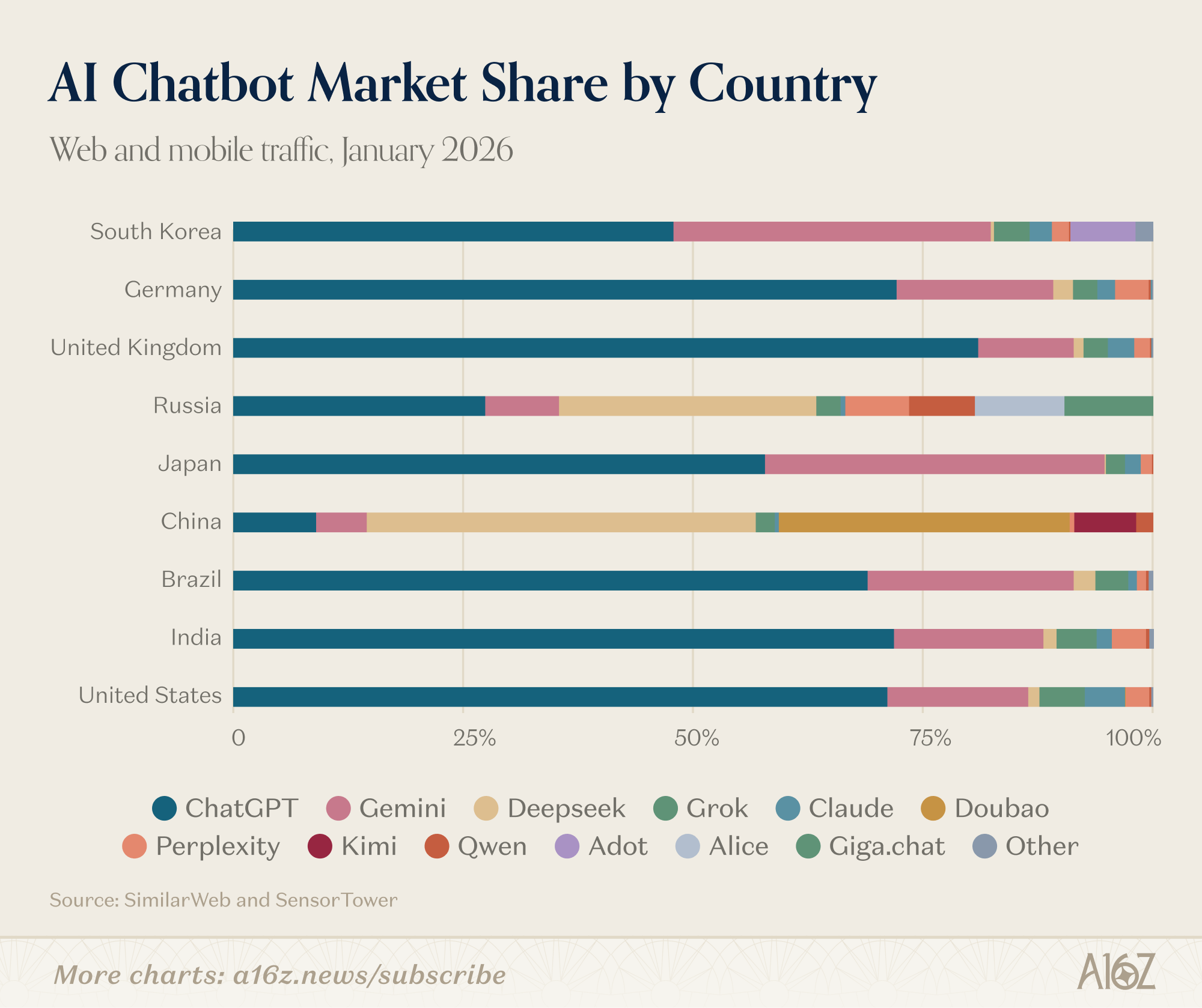
A consumer app founder has no reason to enter that race. The ones who win won't be building horizontal AI assistants. They'll go deep into a specific human behavior - a daily ritual, an emotional trigger, a recurring problem - and become irreplaceable for that one thing.
Suno hit #15 on the list and held its rank from the prior edition. ElevenLabs has appeared on every edition since September 2023. Music and voice stayed defensible as categories, I'd argue because the model giants haven't systematically targeted them yet. There's still room to build behavioral lock-in before the platform absorbs the use case.
Compete on general-purpose AI capability and you lose to companies spending billions. Compete on a specific human behavior and you have a chance.
#Retention is the engine, and most founders still ignore it
The number that matters most in the entire report: ChatGPT has 2.2x higher sessions per user per month on mobile than Gemini. Not total users. Sessions per user per month.
Both ChatGPT and Gemini show best-in-class paid subscriber retention in the US. Not acquisition rates, not viral growth. Retention.
The apps staying on the list aren't only acquiring users fastest. They're keeping them at rates that compound over time. Context accumulates, habits form, switching costs rise. The more an AI knows about you, the better it performs, which drives more use, which generates more context. That's a retention loop.
Most consumer app founders spend the majority of their energy on acquisition. Top of funnel, growth hacks, viral loops. That's not wrong, distribution matters enormously. The error is building acquisition infrastructure before you have a retention foundation that warrants scaling.
If your Day 30 retention is broken, you are filling a leaky bucket with expensive water. Every dollar you put into distribution is diluted by the churn you haven't fixed.
Feature novelty generates downloads. Behavior change generates retention. Most founders build for the first and wonder why the second never shows up.
The usual sequence is build, then distribute, then retain. The order that works is build, retain, then distribute.
Distribution on top of broken retention speeds up the leak. Distribution on top of real retention compounds, and the loop starts to turn on its own.
#Where the giants focus, standalone products die
Three years ago, seven of the nine creative tools on a16z's web list were image generators. Today, only three remain.
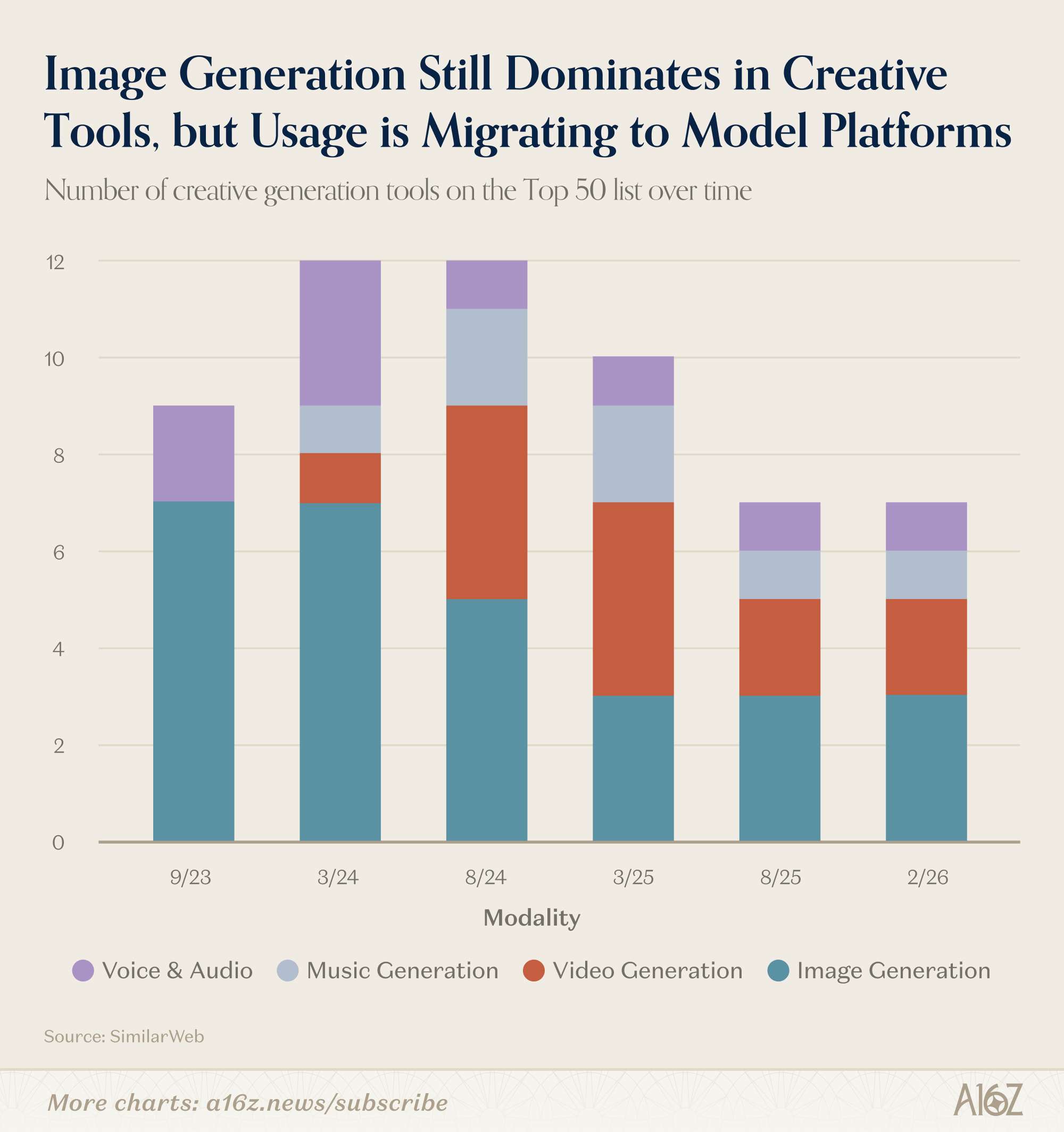
Image generation didn't stop being useful. ChatGPT and Gemini decided to compete directly. GPT Image went native. Gemini's image model brought 10 million new users in its first week. The standalone category got compressed because the horizontal platforms absorbed the use case.
Midjourney went from top 10 to #46.
The products that survived – Leonardo, Ideogram, CivitAI – did it by going more specific, serving defined creative communities rather than competing on general capability.
Meanwhile video, music, and voice filled the gap, which are exactly the categories the giants hadn't systematically attacked yet.
Wherever the giants focused, standalone traffic compressed. Wherever they didn't, there's room to build.
Every consumer app founder should be asking whether their use case is one the horizontal platforms are actively targeting. If it is, my guess is you have 12-18 months before the free tier of ChatGPT or Gemini does 80% of what you do at zero cost to the user.
They will compete with you. What decides the outcome is whether you have enough behavioral lock-in - accumulated context, habit depth, product specificity - that you remain the better choice for your specific user even when the generic option is free.
Most consumer AI apps will die this way. Not because they built a bad product, but because they built a general product in a category the giants eventually decided to enter.
#The four things that compound
Reading across the data, consumer AI apps that compound share four characteristics, and they tend to develop in a specific order.
A daily behavior, not an occasional one. Not weekly, not "when I need it." Daily. The apps with real staying power are embedded in a daily ritual: communication, creative output, health, relationships. The behavior existed before the AI. The AI makes it much better.
If your app is only relevant when a specific problem comes up, you're building a utility. Utilities compete on price. Behaviors compete on lock-in.
Context that accumulates. Every session should build a model of the user - preferences, patterns, goals - that makes the next session better. Apps doing this become personalized infrastructure for their users. Most consumer AI apps treat every session as independent, and leave that moat on the table.
Distribution that meets the user where they already are. The clearest growth signal in this report is that the highest-traction products are increasingly embedded in existing contexts. Agents running in messaging apps. AI inside browsers. AI embedded in productivity tools. You don't need users to come to you if you're already in the flow they use every day.
Retention that earns the right to grow. Scaling before your retention is solid is the most common and most expensive mistake in consumer apps. The vibe coding tools on this list, Lovable and Replit, show revenue growing even as traffic growth slowed from the initial spike. That's healthy maturation. The users who stayed are using more, paying more, embedding deeper. Right now, depth per retained user matters more than breadth of new users.
The AI land grab is over. What replaces it rewards compounding, and most founders haven't updated their mental model to match.
My position is simple: if your Day 30 retention isn't working yet, every dollar and hour you put into distribution is going to the wrong place. Fix the reason people come back before you pay for more people to arrive.
- An