flight-pass is a free, open source (MIT) digital business card for events. A guest scans your QR code, types their name and email, and rides a 10 second rocket flight from Earth to Mars. They land on a boarding pass with your links and a "save contact" button, and you get their details. We built it for TechCrunch Disrupt and App Growth Annual, and it's live at fly.agniverse.co.
Nobody keeps a business card, and a QR code that opens a plain form is easy to close. So we made the form the boarding gate of a flight, and the thing they get at the end is a pass worth keeping.
#What a guest sees
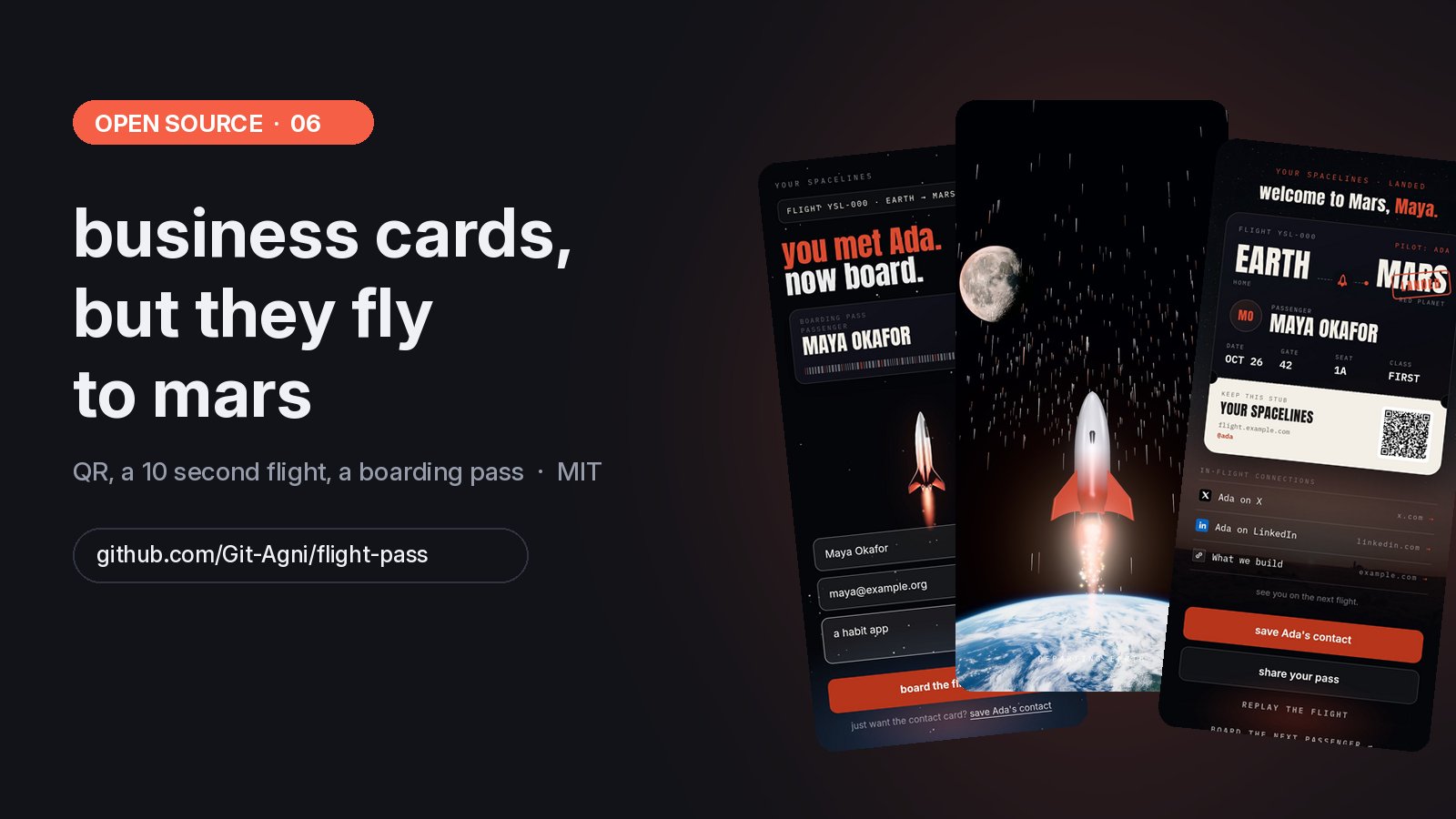
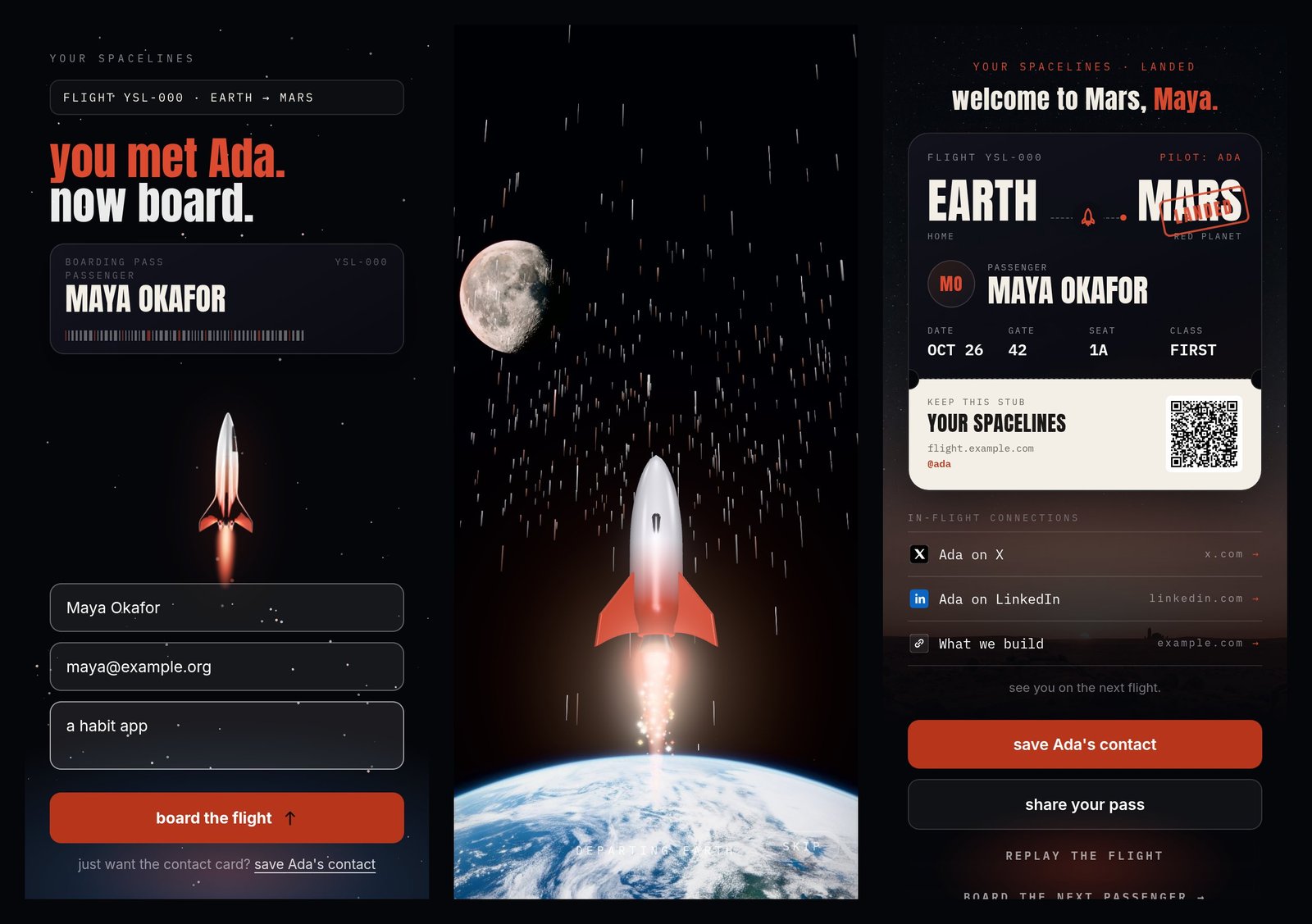
- Boarding. "You met Ada. Now board." Name, email and an optional "what are you building?". The ticket stub fills in as they type.
- The flight. Ten seconds of WebGL. A rocket leaves Earth, passes the Moon, goes round the Sun and comes down on Mars.
- The pass. Their name on a boarding pass with a flight number, gate and seat, a QR code of the pass link, your links, a "save contact" button that downloads your vCard, and a "share your pass" button that renders a 1080 by 1350 image to share.
There's also a "just want the contact card?" link under the form, for people who'd rather skip the ride.
#Rocket, horse or a solid-gold gorilla
You pick the vehicle per host. A rocket, a galloping horse, or a solid-gold gorilla. Or set vehicle: "custom" and fly any 3D model you drop in as a .glb file. It's scaled to the rocket's length and flown on the same path, and if it fails to load, the rocket flies instead.
Every person on your team gets their own route, like /ada, so their own QR code lands guests on their own pass. Print each one on a card, a badge or a phone wallpaper.
#Built to work on a conference phone
Conference Wi-Fi is slow and every guest's phone is different, so a lot of the engineering is about making ten seconds feel instant.
- The flight loads while they type. three.js only loads once the form is on screen, and the scene builds while the guest fills it in, so pressing board plays at once.
- It drops quality before it drops frames. If a phone can't hold about 50 fps in the first second, it lowers the pixel ratio once, while the warp hides it.
- It has fallbacks. No WebGL2 means a 2D canvas flight. Reduced motion turned on means straight to the pass.
- The sound is synthesised, so there are no audio files to download.
- The pass works without a database. The pass link carries the name, host, event and date in the URL itself, never the email. Every pass link works even if you store nothing.
#Where the leads go
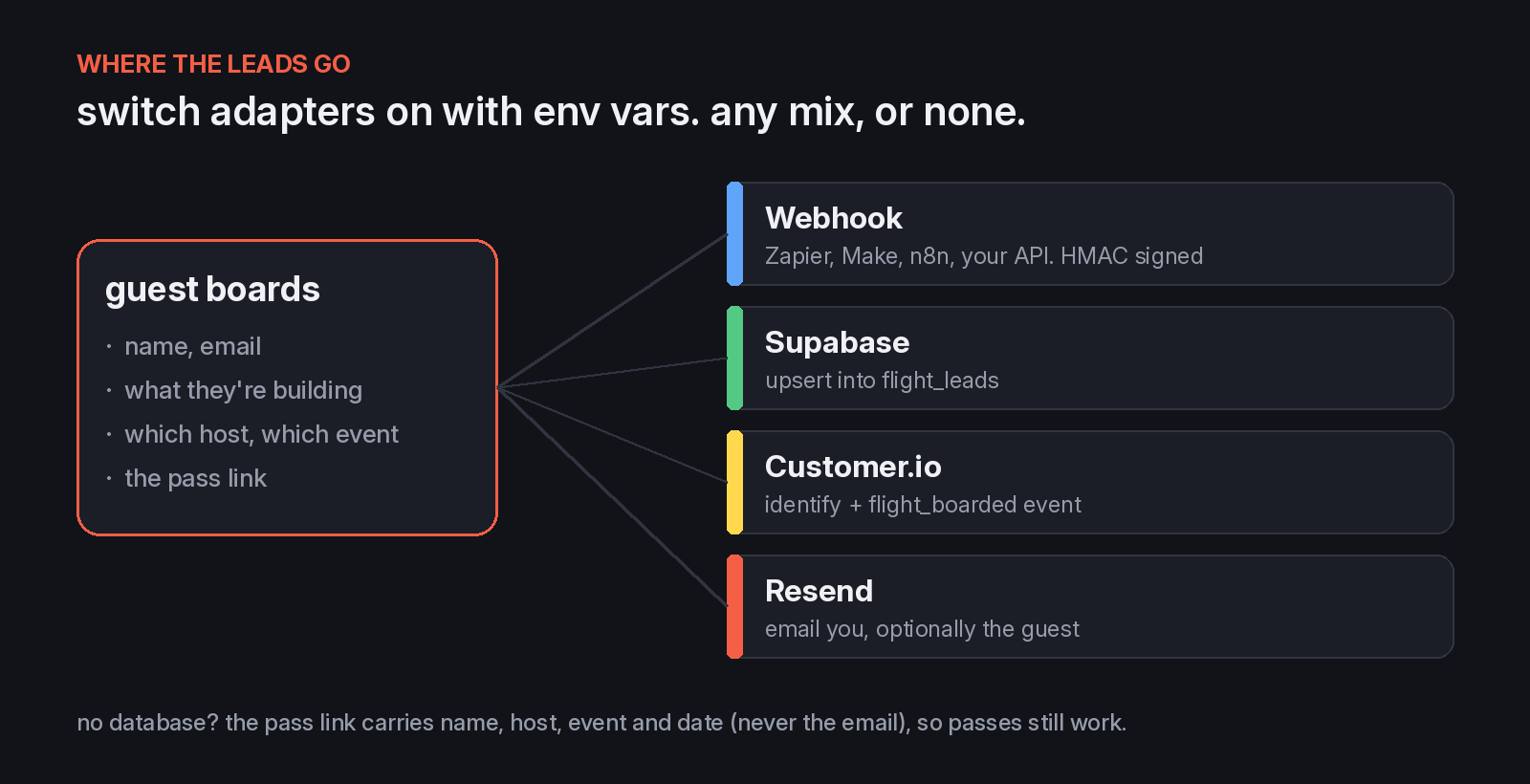
Each lead carries the name, email, what they're building, which host they met, which event and the pass link. You switch adapters on with environment variables:
| Adapter | What it does |
|---|---|
| Webhook | Posts each lead to Zapier, Make, n8n or your own API, signed with HMAC if you set a secret |
| Supabase | Upserts into a flight_leads table, one row per email and event |
| Customer.io | Identifies the guest and tracks flight_boarded, ready for a follow-up campaign |
| Resend | Emails you a "new passenger" note, and can send the guest their pass link |
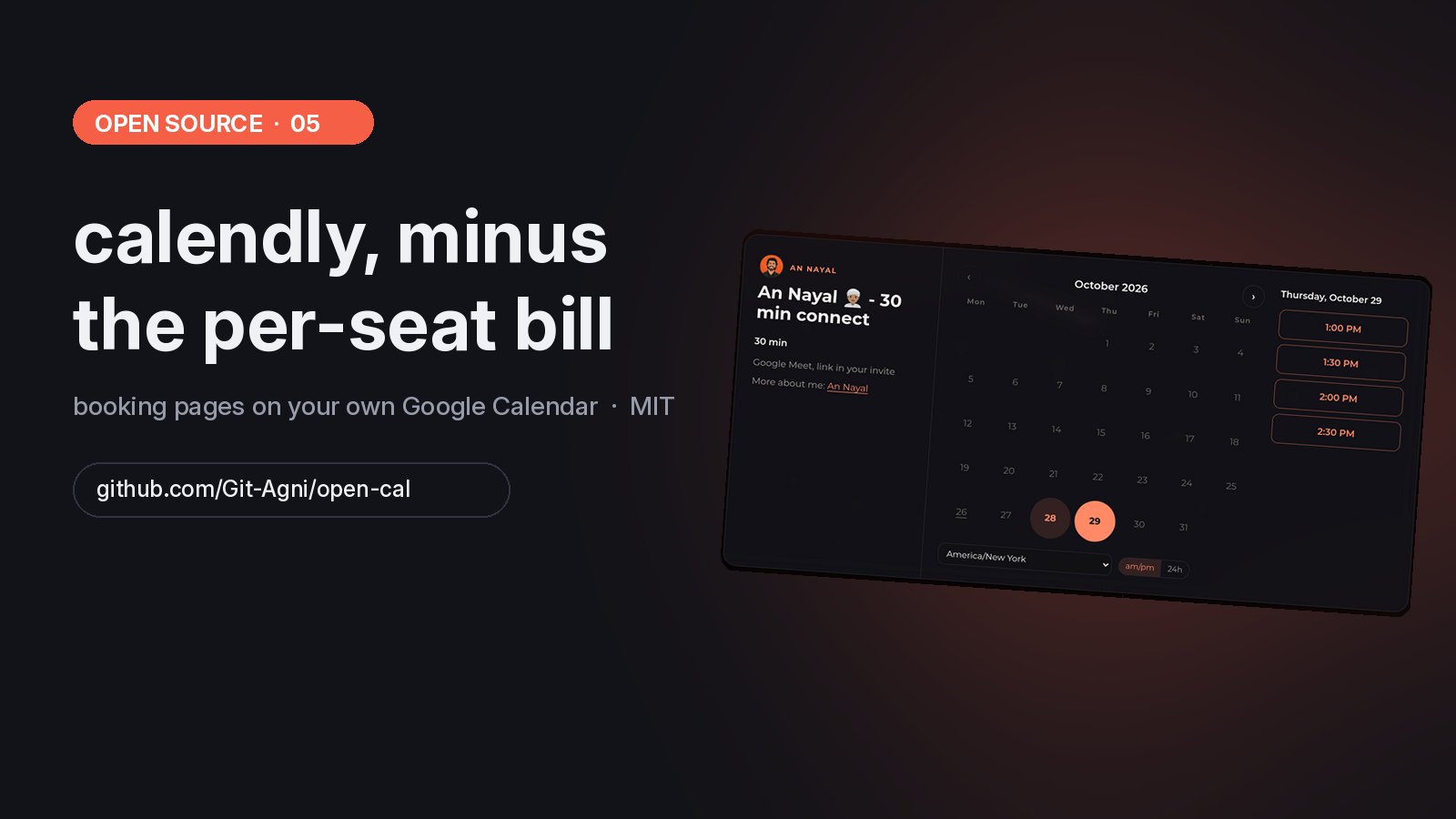
They all run after the response is sent, so a slow service never holds up the flight, and one failing never stops the others. On ours, the follow-up email links straight to my open-cal booking page, so a scan at an event can turn into a booked call.
#Fly your own
git clone https://github.com/Git-Agni/flight-pass.git
cd flight-pass
npm install
npm run dev
With no environment variables set, the flight and the pass work and each boarding is logged to your terminal. Everything you'd change lives in one file, flight.config.ts: your hosts and their links, your events and dates (the event whose dates contain today is picked automatically), the copy, and optional big lines of text that appear during the flight. Colours are CSS variables.
It's a plain Next.js 15 app with no database required, so it deploys on Vercel or any Node host. Point a subdomain at it, print your QR codes, and keep those URLs stable once they're printed.
#FAQ
What is a digital business card for events? A link or QR code that gives someone your contact details and captures theirs, instead of a paper card. flight-pass does it with a short flight to Mars that ends on a boarding pass with your vCard.
Is flight-pass free? Yes. It's open source under MIT. Fork it, change one config file and host it yourself.
Do I need a database? No. The pass link carries everything the pass needs. If you want to keep leads, switch on Supabase, a webhook, Customer.io or Resend.
Does it work on older phones? Yes. It lowers its resolution if a phone can't keep up, falls back to a 2D flight without WebGL2, and skips the flight for people with reduced motion on.
Can I use my own 3D model instead of the rocket?
Yes. Set the vehicle to custom and point it at a .glb file, ideally under 1 MB.
How do guests save my contact? The pass has a "save contact" button that downloads a vCard, plus your links and a QR code of the pass itself.
#Links
- The code: github.com/Git-Agni/flight-pass, MIT
- Board the live one: fly.agniverse.co
- The launch post on X: x.com/consumerxai
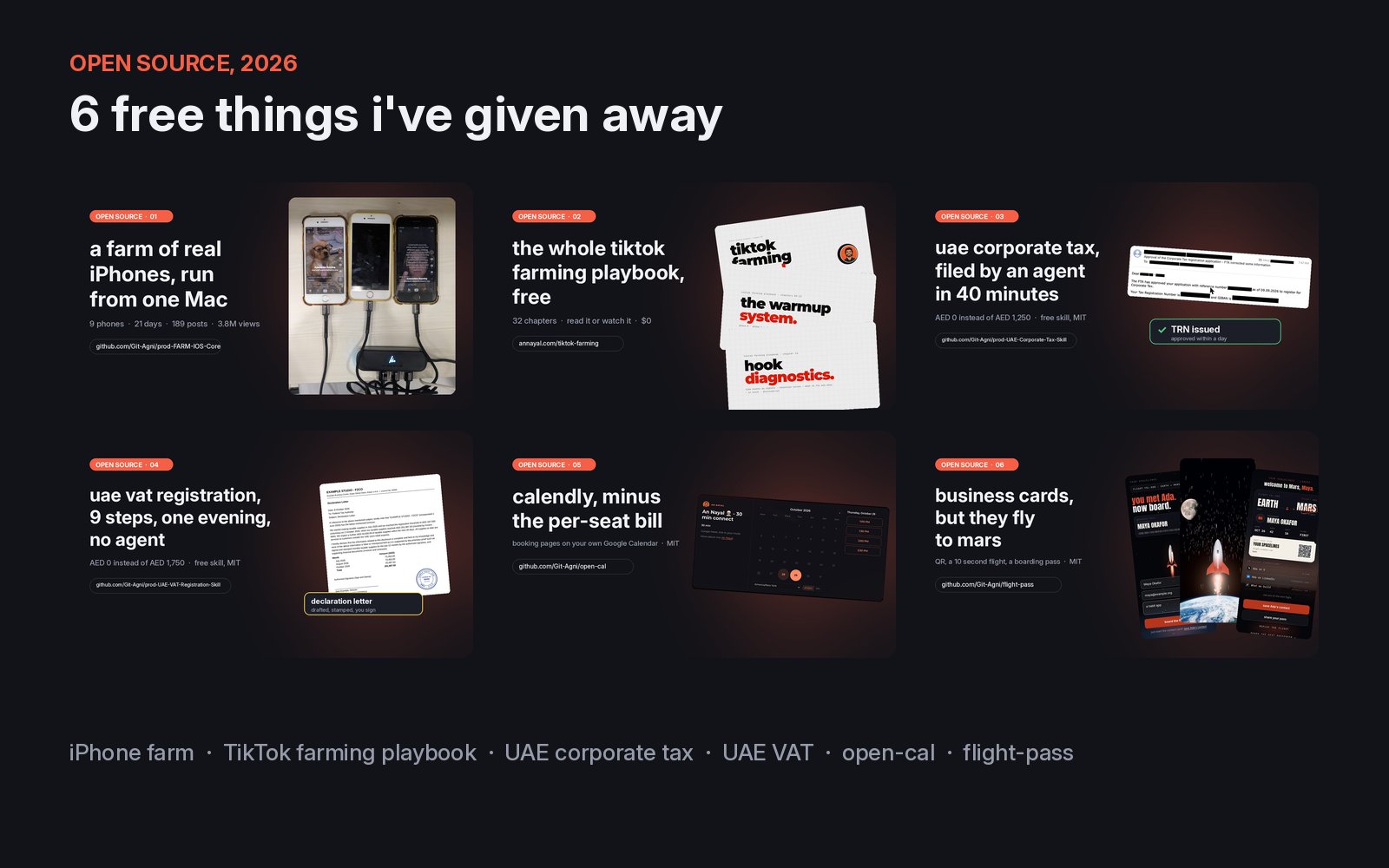
- More in this series: the open source iPhone farm, the TikTok farming playbook, UAE corporate tax, UAE VAT, open-cal